Drug Trials Data: A Consumer's Guide
Purpose of this page: This page is meant to help patients, caregivers, students, and other motivated consumers research pharmaceutical drug trials and pull useful insights (knowledge) out of publicly available trial data - things like how well a drug worked, how safe it was, and who it was actually tested on.
Data Sub-Genre Focus: Clinical Drug Trials
Every prescription drug goes through a series of clinical trials before (and often after) it is approved. Those trials generate huge amounts of structured data: how many patients were enrolled, what doses were tested, what side effects occurred, and how outcomes compared between a treatment group and a placebo or comparison group. Several government and medical databases publish this data for free, and a motivated reader who knows where to look and how to read the tables can learn a great deal about a drug's real-world risks and benefits - often well beyond what a glossy drug commercial or a pharmacy pamphlet would tell them.
What Information Is Available?
Drug trial databases generally publish information such as study design (phase, number of arms, randomization), enrollment numbers, dosing, adverse events, and outcome measures (the specific results the trial was designed to test, such as tumor response rate or survival time). Some sites focus on the raw registry data (what trials exist and what they found), while others translate that data into consumer-friendly summaries, or publish independent expert analysis of what the results actually mean.
Example 1: Reading an outcome measures table on ClinicalTrials.gov
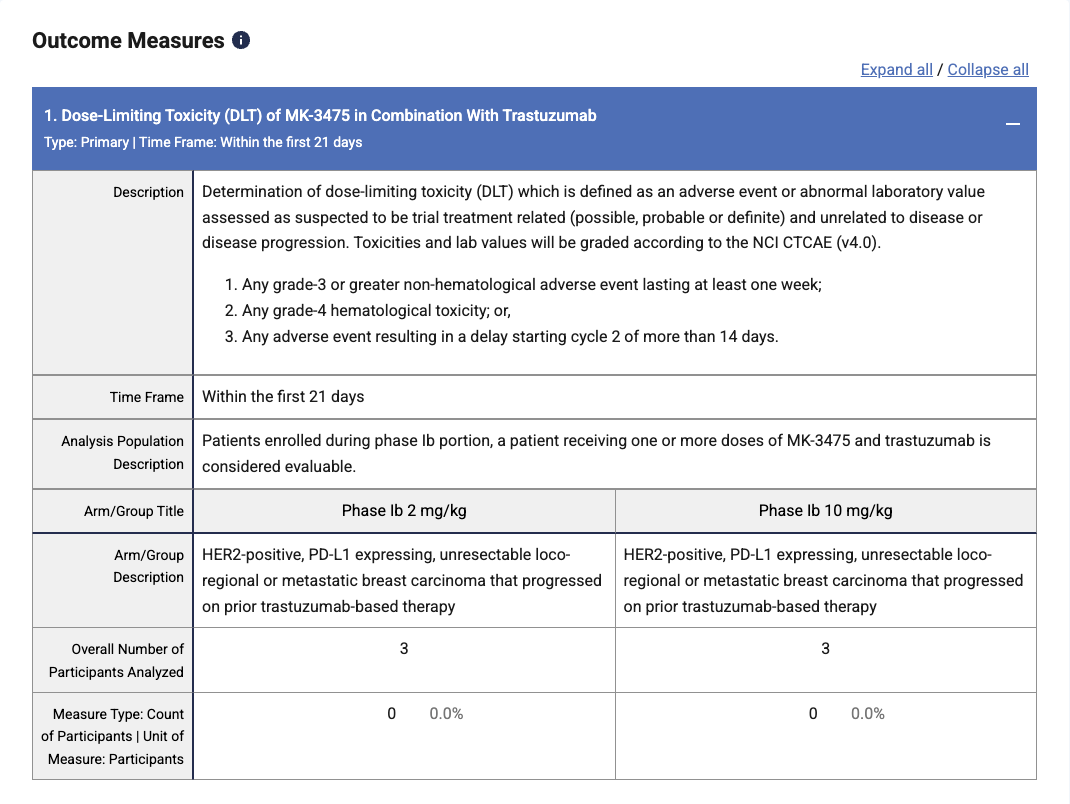
Outcome measures table for a Phase Ib/II pembrolizumab breast cancer trial (NCT02129556), showing the dose-limiting toxicity results by treatment arm. View on ClinicalTrials.gov
ClinicalTrials.gov study NCT02129556 tested an anti-PD-1 antibody (pembrolizumab) combined with trastuzumab in patients with advanced, trastuzumab-resistant HER2-positive breast cancer. The posted results include a "Participant Flow" table and an "Outcome Measures" section that breaks results down by arm - in this case a 2 mg/kg dose group and a 10 mg/kg dose group. A consumer reading this table can see, arm by arm, exactly how many patients were analyzed and how many experienced a dose-limiting toxicity (in this small early-phase group, zero patients in either dose arm did), giving an early read on the drug's safety before it ever reaches a pharmacy shelf.
Example 2: Reading a demographic breakdown on FDA Drug Trials Snapshots
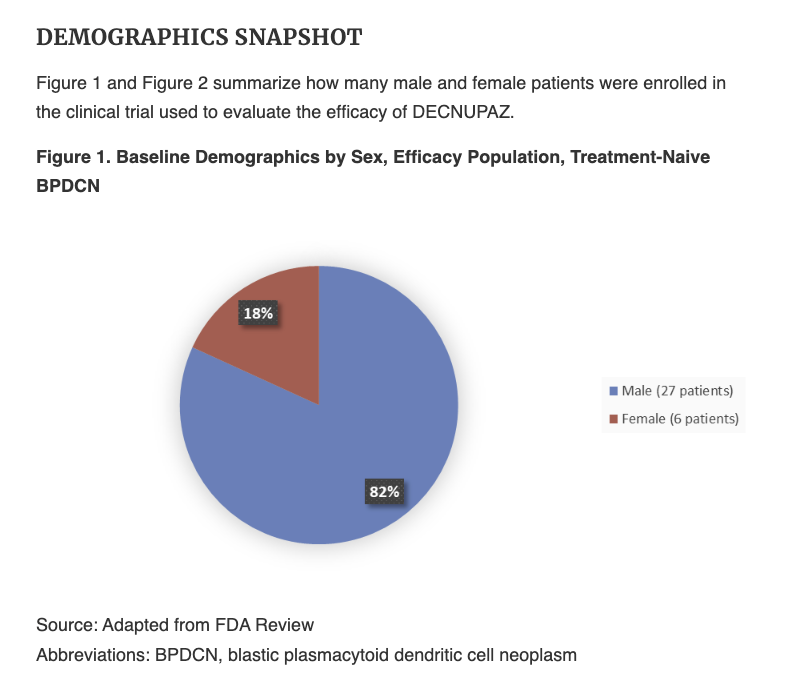
Baseline demographics by sex for the treatment-naive efficacy population in the DECNUPAZ (pivekimab sunirine) approval trial. View on FDA.gov
The FDA's Drug Trials Snapshots translate the trial data behind a drug's original approval into plain-language demographic charts. For DECNUPAZ, a drug approved for a rare blood/bone-marrow cancer, the chart shows that the treatment-naive efficacy population was 82% male and only 18% female. A motivated consumer can use a chart like this to ask an informed question: was this disease's own patient population already skewed male, or were women simply underrepresented in the trial? Either way, it tells the reader something about how confidently the results generalize to them personally.
Example 3: Reading a peer-reviewed summary on PubMed
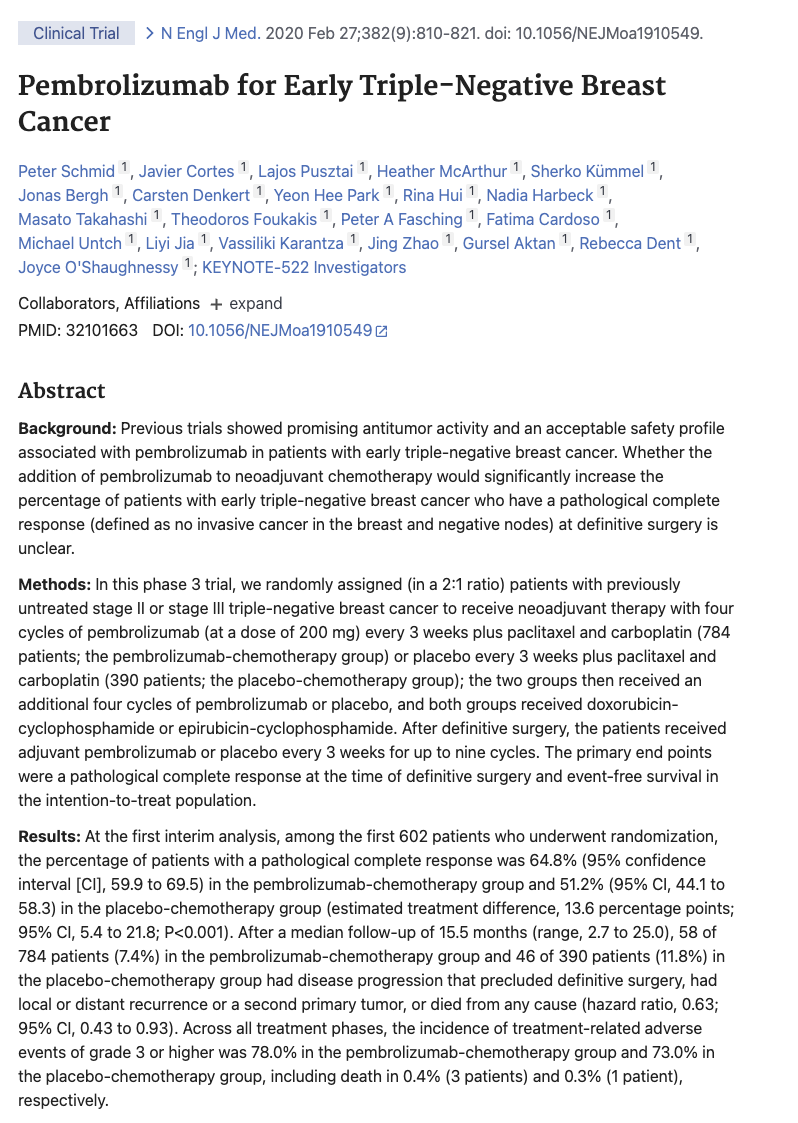
Abstract of the KEYNOTE-522 trial publication in the New England Journal of Medicine, summarizing pathological complete response rates. View on PubMed
Registry data is useful, but a peer-reviewed publication adds statistical context that a raw table usually will not spell out. The PubMed abstract for the KEYNOTE-522 trial reports that patients who received pembrolizumab along with chemotherapy reached a pathological complete response about 13.6 percentage points more often than patients who received chemotherapy alone, a gap large enough that the study authors considered it statistically meaningful. For a consumer, that single comparison is often the most useful number in the entire trial: it turns a wall of raw numbers into a plain before-and-after comparison they can bring to a conversation with their own doctor.
A raw data table tells a consumer what happened in a trial. A demographic chart tells them who it happened to. A peer-reviewed article tells them whether it mattered. Reading all three is what turns a clinical trial listing into real insight.
Web Resources for Drug Trials Data
Below are three diverse sources for drug trial data: a government trial registry, a regulatory agency's consumer-facing summaries, and a peer-reviewed literature database. Together they let a reader move from raw data, to who the data applies to, to expert interpretation.
 ClinicalTrials.gov
Landing page: ClinicalTrials.gov - run by the U.S. National Library of Medicine, this is the primary public registry of clinical trials worldwide, including both the trial design and (when available) the posted results.
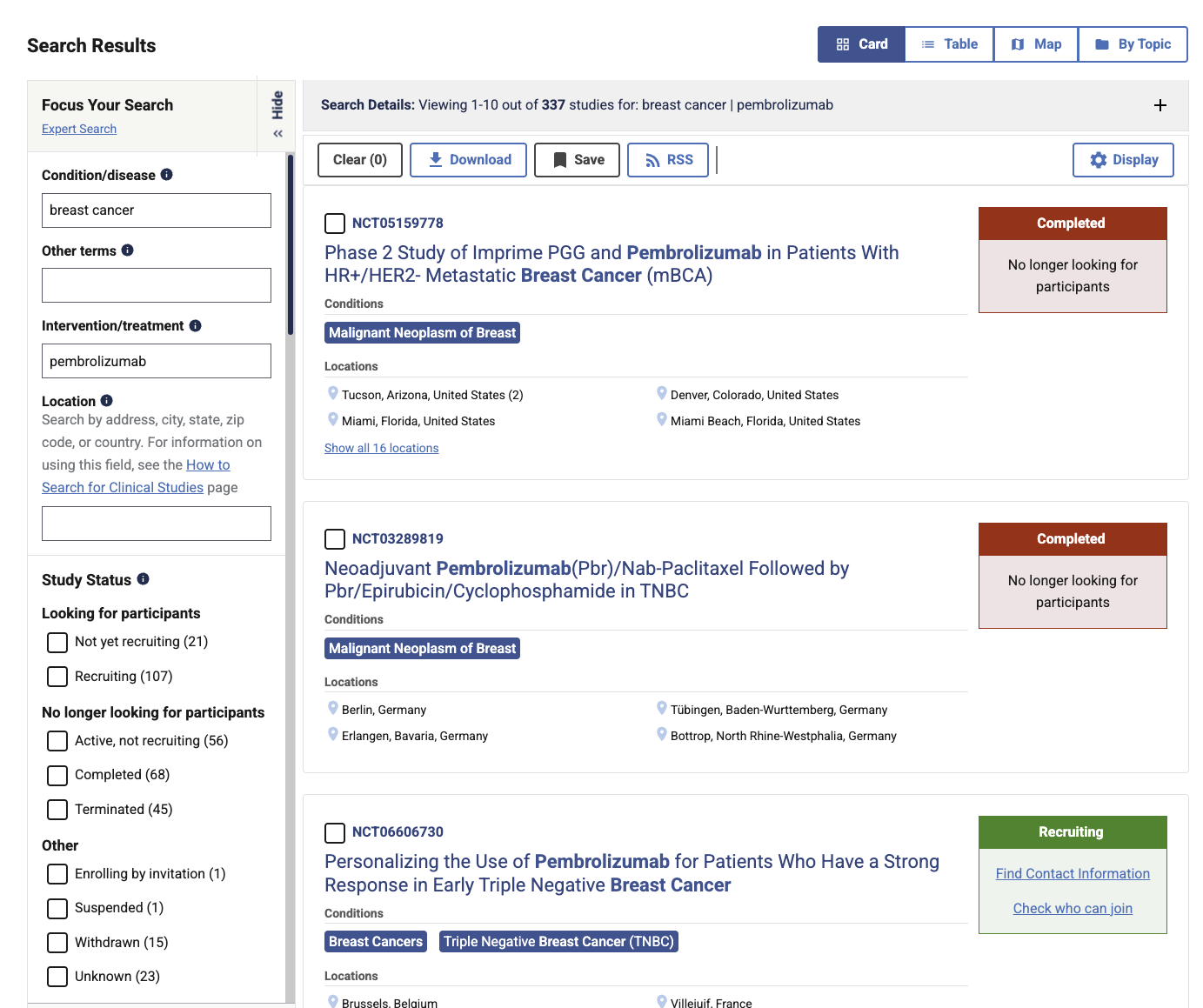
Search results for "breast cancer" and "pembrolizumab" showing multiple matching trials with their status and locations. View this search on ClinicalTrials.gov
 FDA Drug Trials Snapshots
Landing page: Drug Trials Snapshots - a U.S. Food & Drug Administration resource that summarizes, in consumer-friendly language, who participated in the trials that supported a drug's original approval.
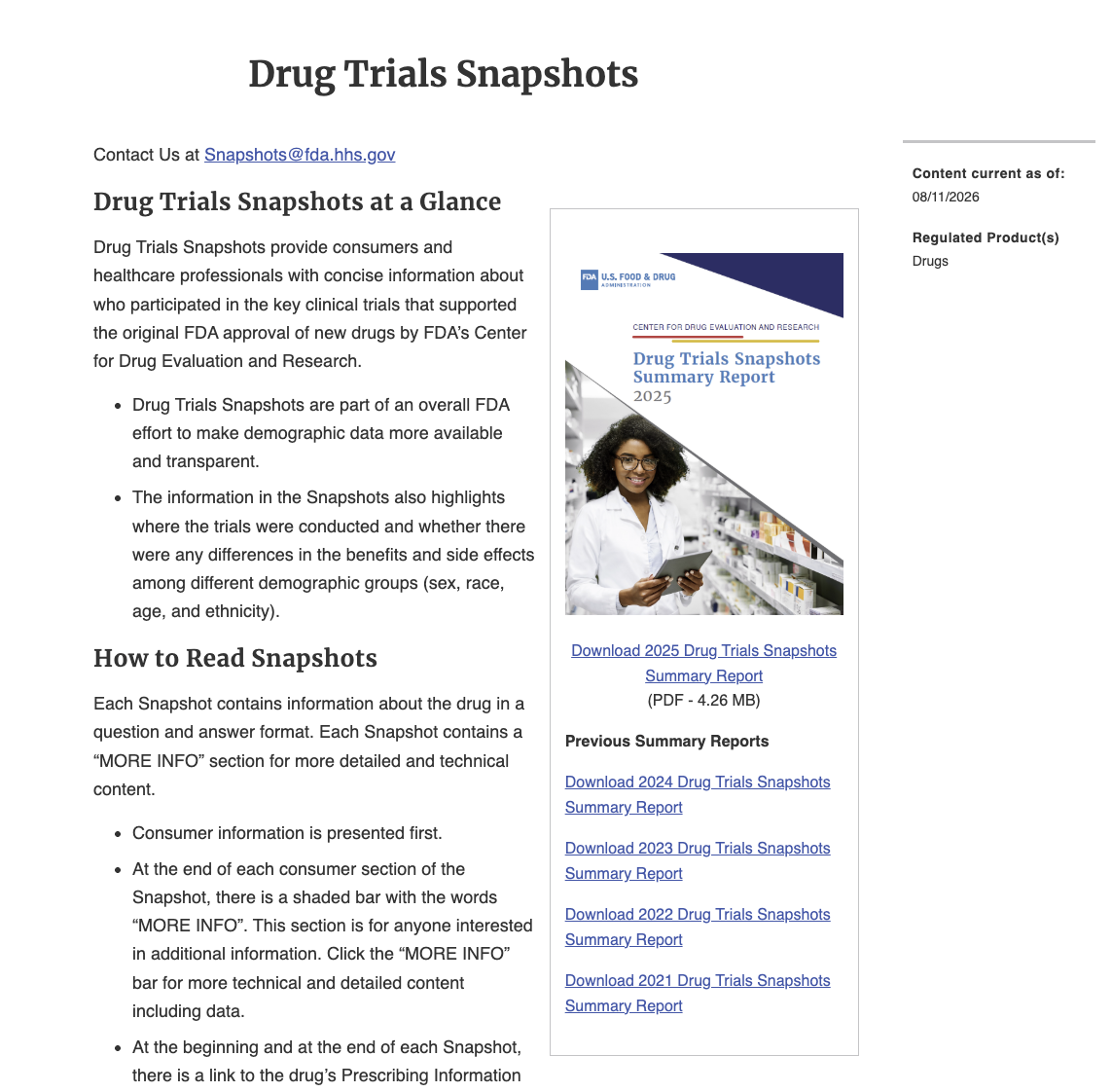
The Drug Trials Snapshots landing page, listing individual drug snapshots with their approval dates. View on FDA.gov
 PubMed
Landing page: PubMed - a free search engine, maintained by the National Library of Medicine, for peer-reviewed biomedical literature, including the published results and expert discussion of clinical trials.
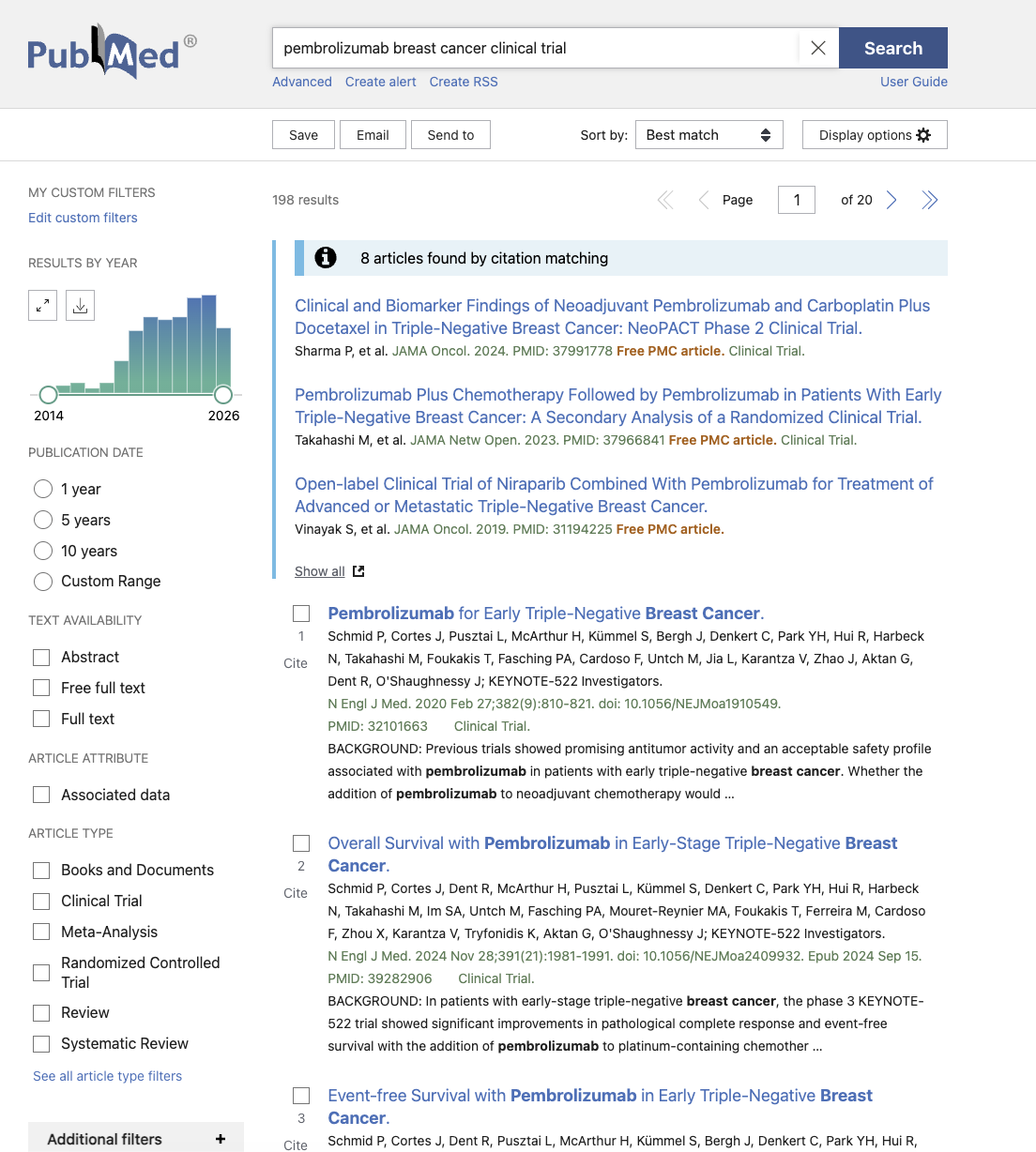
PubMed search results for "pembrolizumab breast cancer clinical trial," including the KEYNOTE-522 publication. View this search on PubMed
How to Use These Three Resources Together
A motivated consumer researching a specific drug or condition can move through these resources in order. Start broad on ClinicalTrials.gov to find out what trials exist for a drug or condition and what their raw results were. Then check FDA Drug Trials Snapshots to see who was actually enrolled in the pivotal trial that got the drug approved - this tells you whether the results are likely to apply to someone like you. Finally, search PubMed for the published, peer-reviewed version of the same trial, which usually includes statistical significance testing and expert discussion that the raw registry entry does not.
Walkthrough: Sample Analysis
The following walkthrough shows how a consumer researching pembrolizumab for breast cancer could use all three resources together to reach an informed insight.
- Search the registry. On ClinicalTrials.gov, search "breast cancer" as the condition and "pembrolizumab" as the intervention, then filter to "Studies with Results" so you only see trials that have posted data.
- Open a completed trial's results. Click into a completed study and open its "Outcome Measures" section to see the actual numbers - response rates, toxicity counts, and how many patients were in each arm.
- Check who was tested. Search the drug's brand name on FDA Drug Trials Snapshots to see the age, sex, and race/ethnicity breakdown of the trial's efficacy population, so you know how broadly the results generalize.
- Find the expert write-up. Search the same trial's name or drug on PubMed to find the peer-reviewed journal article, and read the abstract for the statistical comparison between the treatment and control groups.
- Draw the insight. Combine the three: for example, "the trial showed a 13.6 percentage-point improvement in response, the pivotal trial's efficacy population skewed toward a specific demographic, and the published article confirms the difference was statistically significant" - a concrete, sourced insight a patient could bring to their own doctor.

The pathological complete response comparison highlighted in the KEYNOTE-522 abstract - the single number that answers "did the drug actually help?" View source on PubMed
Useful drug trials resources:
- ClinicalTrials.gov: the primary U.S. government registry of clinical trials and posted results.
- FDA Drug Trials Snapshots: consumer-friendly demographic summaries for newly approved drugs.
- PubMed: free search of peer-reviewed biomedical literature, including published trial results.
- WHO International Clinical Trials Registry Platform: a global registry that aggregates trials from many countries beyond the U.S.